
THE BASICS: WHERE – FACTOR 3: Health

 Mobility and other constraints: Significant mobility issues, current or future, can’t be ignored as a top factor to consider when deciding where to live. It may not necessarily limit what towns you consider, but it should certainly be a consideration in your choice of housing. Mobility can matter in multiple ways such as what floor do you live on? How close are shops, transport and healthcare facilities?
Nearly every town in France you are likely to be considering will have a range of options: very modern (think elevators, ramps, etc.) and very, very old buildings (think steep, stone, curving, uneven steps, difficult bathtubs). People who come from countries younger than France (US, Canada, Australia, etc.) will be surprised at some of the difficulty of navigating one’s way around an ancient old town or up a centuries-old staircase. If mobility is an issue, or it may become one, ‘access’ should be at the top of the list of priorities. If you plan to stay in France for the rest of your life, mobility and access issues should be on your radar, even if they are not currently a concern.
 An example of a way that may play into your decision: many of our favorite towns have brand-new tram systems that make it easy to get on and off in a wheelchair. Montpellier (pictured left) , Bordeaux and Angers all come to mind as each city has highly accessible tram systems, large areas of very modern housing and lovely ancient parts of town with visual appeal (but perhaps not for living in), when your mobility is limited.
Other constraints might influence one’s choice. Seasonal allergies are significantly worse in some areas of France than others. Respiratory issues may cause you to check out air quality using one of our recommended data comparison sites. France has greatly improved access issues for the disabled in the last two decades, but a medieval center is a medieval center and its older parts are never going to be easy going.
Services: It may be helpful at this initial assessment stage to go over briefly some of the services you can expect from French healthcare as a legal resident. In clear and subtle ways, it may affect your choices of where to live.
Many people who’ve moved to France list French healthcare as one of the best things about their move. French healthcare is frequently rated as one of the best systems in the world:
- Every person legally residing in France for more than three months is entitled to be enrolled in the state healthcare system, called Protection Universal Maladie. The French operate on the principle that healthcare is a human right.
- After you’ve resided in France for three months continuously, you are entitled to enroll in the healthcare system. While you can apply, the times vary greatly in how quickly the application is processed. Luckily, if you are accepted into the healthcare system, you will be reimbursed for costs you incurred between when you applied and when you are accepted.
- The reimbursement for healthcare is called the Sécurité Sociale (not at all related to ‘Social Security’ in the US system) and your payments to that system are based on your income. As of this writing,(2026) there are likely to be changes coming for residents who have not paid into the system as employees (For, example, a retiree from the US.) and there is likely to be an annual charge, no matter what your income. It is not clear what the amount of the annual charge will be but it is highly unlikely to be near the cost for healthcare in the US.
- Generally, you will have a médecin traitant (primary care physician responsible for your overall health.) You are also entitled to reimbursement from many specialists, though for some, you will need a referral from your primary care physician.
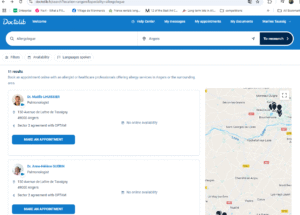 Initially, finding a doctor in France is often done using one of the apps available. Doctolib.fr is perhaps the most well known. There is a shortage of doctors in France (though not as severe as in the US). It depends very much on where you live whether such a shortage will affect you. Using an app, a survey of the areas you are interested in will give you a rough idea of doctor availability and wait times. In general, as you might expect, top-notch medical care will be in the larger cities. Paris, Lyon, Marseille, Toulouse, Bordeaux, Nice, Strasbourg, Montpellier, Nantes and Lille are listed as the top ten French cities for medical care. The provider shortages, when they exist, are often in smaller towns and rural areas. Generally, the complaint you may hear about French healthcare will be about availability. While no system is perfect, complaints about the quality, expertise or costs of French healthcare are very rare indeed.
- A general practitioner visit generally costs around €25, with patients in the healthcare system reimbursed about 70% by the state.
- Many retirees opt for complementary health insurance (Mutuelle) to cover remaining costs. Premiums can range from €30 to €100 per month, depending on the level of coverage. Mutuelles are often called ‘top-ups’ as they cover what the national coverage does not. You can choose from a wide range of options for coverage.
- Once in the system, all the billing and reimbursement both from the state and Mutuelle is automatic (your reimbursement is deposited into your bank account). This surprising lack of paperwork also exists in the doctor’s office, where you’ll encounter almost no paperwork (or even intermediary staff nurses, technicians, office staff etc.).
- ALD refers to Affections de long durée (long-term condition) which are 100% reimbursed by the state.These include cancer, diabetes, cardiovascular, chronic respiratory and neurological conditions, HIV/Aids, kidney, mental, autoimmune diseases as well as severe disabilities.
ADDITIONAL RESOURCES:
1.  Some good general advice on mobility issues can be found here on the Les Frenchies YouTube channel, specifically from the beginning to 4 minutes.
2. An excellent resource for finding (and avoiding) the medical deserts.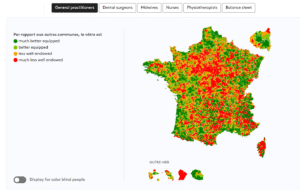
3. Our favorite How-to: video for enrolling in the French healthcare system: An Scott from their channel, Postcards from our Golden years: UNLOCKING THE SECRETS TO FRANCE’S HEALTHCARE SYSTEM: JOIN ME AS I SHARE OUR EXPERIENCE SIGNING UP! at https://youtu.be/IQB5C-OLhyQ?si=uRYbQ2g4tlSNdnz5
4. To get a fairly broad view of how expats have experienced healthcare and serious health challenges in the system, (both good and bad) reading through the 179 comments on this FB link may be helpful.