THE BASICS: WHERE – FACTOR 2: Transportation
Do you want to own a car? This is critical. Don’t even start looking for towns till you have a fairly firm answer to this question.
Why you might want to own a car?
- Smaller town shopping: In the past two decades larger stores (hypermarches) have moved to the outskirts of the towns (much to the detriment of the smaller town merchants. The advent of chains (like LeClerc, etc.) has meant many merchants that were in the heart of villages have gone out of business. Those larger superstores of all kinds (DIY, fast food) are more than likely a 1 – 2 km walk outside town — impractical for daily shopping unless you have a car. Moreover, if you purchase a large item, lugging it home on a bus, train or tram will not be easy.
- Spontaneity: While France’s public transportation and, in particular, its trains, are some of the best in the world, all public transportation goes by a schedule. If you want to go when you want to go, you need a car. Much of public transportation’s schedule is built to facilitate school students and workers. This means that regular bus routes may suddenly dwindle during school holidays, weekends or after work hours. If your chosen town doesn’t have a train station, but is served by bus, look closely at the schedules. You’ll often find that it’s a well-served, reliable route…during the commute hours on workdays, and when school is in session. At other times, you may find there is no bus at all. Helpful to keep in mind that the people the bus lines are usually designed for are workers and students. So time of the day, and the school calendar can vastly change the ability to depend on bus transportation. If choosing a town where you plan to depend on bus, DO look carefully at school holidays and weekend schedules to see if they are sufficient.
- Wandering: Finding where you want to live is as much an art as it is a science. Something we’ve heard countless times, when talking with people making scouting trips is “I would have never imagined I would want to live _____________, but we happened upon it and fell in love.” ‘Happening upon’ is a gear better suited to an automobile than public transportation. You can change the route, linger longer, hit the out-of-the-way spots. All of which are nearly impossible on public transportation.
Why might you not want to own a car?
- French Public Transportation is fantastic:
- Good coverage in larger cities. In particular many cities have developed wonderful, clean, easy-to-use tram systems that cover the centers and some of the periphery as well. In many of these cities, the transportation system inside the city is free for all residents.
- Great trains: You’ve likely heard of the TGV (Tres Grand Vitesse , aka high speed trains) but France’s trains hold their own with the widely praised Swiss and German trains in punctuality and cleanliness. And they are usually quite a bit less expensive, especially if you use some of the discount cards available. The app (sncf-connect.fr)for the train has improved vastly in the past few years, and you will encounter few, if any, glitches. You purchase your tickets on the app, and then show the ticket-taker the ticket which resides on your phone.
- Buses, (IncludingFlixBus and BlaBlaCar Bus). Flix and BlaBlaCar buses are relatively new options but can be great, affordable intercity options. Local and regional buses tend to serve the smaller towns and more rural area and are generally quite reliable. The schedules can be tricky to read, but it’s important to master that skill as schedules can change dramatically on weekends and holiday periods. Buses used to be terrible in France; they are for the most part clean and reliable now, but not always as frequent as one might want, especially in less populated areas.
- The driver’s license dilemma: If you are lucky enough to come from a country where you can exchange your driver’s license, or, if from a state in the US that has an agreement (Arkansas, Colorado, Connecticut, Delaware, Florida, Illinois, Iowa, Kansas, Maryland, Massachusetts, Michigan, New Hampshire, Ohio, Oklahoma, Pennsylvania, South Carolina, Texas, Virginia, and West Virginia), this is not much of a factor. If you are not, it’s a big deal. The French driver’s license exam, both written and road test are notorious difficult and are not always available in English. There are people who have driven all their life, and after years of trying have still not passed. There are people who move to another state and establish residency in that state, and obtain a driver’s license simply to avoid having to pass the French driver’s licencse.
- Parking and driving are neither easy or cheap. They’re also less fun.
- Not easy:
- Driving is a good deal more challenging in Europe than North America (though perhaps less challenging than the UK.) Roads are narrow, and in the oldest parts of French cities, not built for a modern car. Toll roads are more prevalent for longer trips and tolls are more expensive
- Parking is a nightmare everywhere except the countryside and small towns. In even mid-sized towns, you may either need to pay for a garage or walk long distances from where free parking is located to where you live. If you do use public parking, it is not unlikely that your car will suffer minor damage on occasion, due to the shortage of parking places and the narrowness of the roads – we’re talking frequent dings and mirror damage. In many urban areas, parking is either very difficult to find, or perhaps not available at all, as certain zones are reserved only for town residents who have the appropriate sticker.
- Not cheap: A reasonable estimate of costs are between €5000 and €7000 a year (using a mid-range figure in terms of costs, mileage and location)
- Amortized Car Cost: €1,500
- Insurance: €700
- Fuel: €1,500
- Maintenance: €750
- Amortized Registration/Tax: €200 (averaged over several years)
- Parking/Tolls: Variable (based on where you live and drive, let’s estimate €500 – €1200
- Less fun, more lonely: Many people considering moving to France cite living a car-free life as a prime reason for moving! Because France’s towns and cities were established long before the advent of the automobile, most of the centers are not built for cars. This meant that life was organized differently. Merchants were within walking distance, which means you saw your fellow residents in settings where conversation and acknowledgment were possible. Today, in these zones (many of them recently zoned for pedestrians only) , you see your local merchant, usually every day. They know you. In a place where one need not drive for most of one’s everyday needs, there is an enjoyable connection and proximity to people, as you go about your day. It is a far less isolated existence than when one resides in a place where a car is a must.
- Not easy:
- Want to know more about a No Car Life in France. Listen to three different experienced expats talk about why they chose no car….and in once case, changed their mind! Click here to listen!
.png)

Do you plan to travel frequently, and if so, to where?
- Will you be returning to your original place of residence frequently? THINK AIRPORT! If you are coming and going to North America, the only airports that fly direct between France and the US (at the time of this writing) are Charles de Gaulle and Orly, in Paris, and Nice in the South of France (Currently Nice flights operate only in the warmer months) Of these three airports, Charles de Gaulle has far more flights to and from North America. Bottom line: if you plan to return to North America frequently, how to get to Charles de Gaulle Airport in Paris will be a VERY important question. If you are coming and going from a UK or other European destination, you have far more choices. Short-hop airlines like RyanAir, EasyJet and others serve many smaller regional airports and can get you directly to the city in UK or Europe you desire.
- If you are of retirement age, trans-Atlantic travel will become more physically stressful as time goes on. Seriously consider booking a night at the hotel, coming and going. Arriving, you are likely to need rest and wrangling over train tickets or rental cars after not much sleep is hard for anyone, but even harder as you age, and even harder if you’re not familiar with the system.
- If you’ve traveled transatlantically, and you do want to forge on to your final destination on the same day as your arrival at CDG airport, Terminal 2 DOES have a train station inside the airport. If you’ve landed in Terminal 2, it’s just an escalator ride down. If you’ve landed in Terminal 1 or 3, It’s a short inter-terminal rail line ride (That line is called CDGVAL) away if you’ve landed in another terminal. The airport is clearly marked.
- French train travel is far more comfortable than nearly any airplane seat. This is not an impossible notion. Just be prepared to be tired on this last leg. Once you know what terminal you are in, simply navigate via the shuttle (CDGVAL) to Terminal 2. Take two escalators down from the arrivals level, (Look for sines to GARE) and you’ll find a well-marked, clean and safe waiting area, with trains and their track numbers announced and displayed about 20 minutes before departure. We recommend downloading the SNCF app (https://www.sncf-connect.com) for trains before you arrive and booking your train ticket ahead of time. If you are on a TGV train (which is nearly always preferable), reservations are mandatory. The reservations include a seat number and the place you need to stand along the track in order to be near your seat will be displayed on monitors on the track. Many of these trains are very long indeed, so don’t neglect locating the train car you’re in (printed on your reservation) via the monitor on the track. Most tracks have the length of the waiting area divided into letters. You’ll see on the monitor where the car you want will stop along that lettered stretch of track. Seat numbers are usually located on top of the seat itself, but it varies. (Occasionally the seats are listed on the wall next to the row. In addition, look above the doorway or in the entry area of the car you are boarding. Many times, it will display the range of seat numbers in that car.) For more information, consult the excellent site, Seat 61 that is an encyclopedia of European trains: https://www.seat61.com/european-train-seat-maps.htm#France
Believe it or not, the last leg of transatlantic travel can be the straw that breaks the camel’s back, especially if your budget is modest (e.g. you flinch at the price of an airport hotel) and your mobility is not what it once was. While choosing a town simply because it is on the TGV lines of France may seem odd, rest assured that making the trip home and back again easy may just mean you see your family more often, because the journey is not so daunting. To that end we offer this visual: 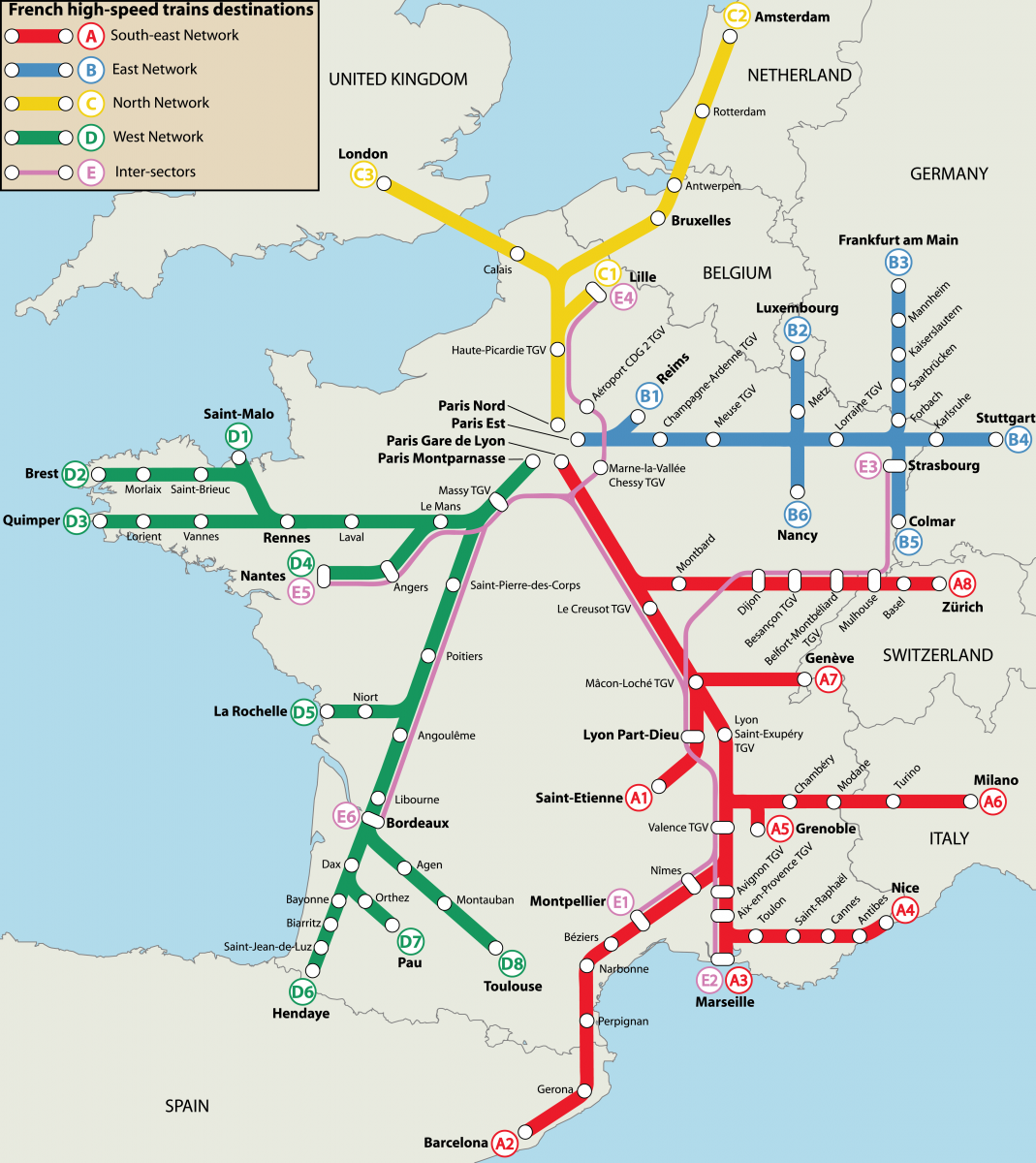
Note on the map above, the thinner purple line which shows train routing from the CDG airport. (not Paris).
.png)
A warning: Paris has seven train stations: Gare du Nord, Gare de l’Est, Gare de Lyon, Gare Montparnasse, Gare Saint-Lazare, Gare d’Austerlitz, and Gare de Bercy. Getting between them is highly unpredictable and depends on luck, the time of day and Paris traffic. We resolutely advise you NOT to take a train to Paris and then navigate to another station the day you arrive. If you are not stopping in Paris, book your ticket from CDG, not from any of the train stations in the city.
Do you plan to travel throughout Europe frequently? 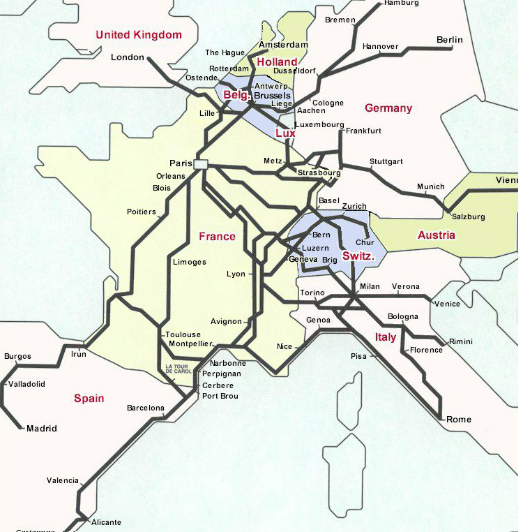
If so, think both about transportation and geography when choosing where to settle in France. Thinking of air transportation, consider that several of the more prominent short-hop airlines have robust hubs in France. (Ryanair: Marseilles, Toulouse, EasyJet: Nice) If one lives in Toulouse, for example, one can go to Dublin or Vienna for a day or two for a song. The same thing goes for Nice; hop on an EasyJet to Prague or Copenhagen for next to nothing. (Just expect bare-bones service along with the bargain prices of most of these carriers.)
In addition to flights, consider the ease and comfort of train travel. (See rail map above right) In the case of trains, it is important to note that, by and large, train routes in France can be thought of as a wheel, in which Paris is the hub. This is slightly less true if one is focused on trips mostly to Spain (easy direct train connections from most of the main cities of the south), Italy (from Marseille and the east). Similarly, Eastern France towns will go directly to Germany/Switzerland (the cities of Geneva, Basel, and Strasbourg). Night trains may be an option for longer trips if you prefer trains to flights.
Additional Resources
- If you are enrolled in the Try-It-Out-Trip (A Life in France) goe to Resources for the Trip link in your community clubhouse to see aVideo with relevant pictures of how to navigate to the train station within CDG
- Good-sized airports throughout France served well by short-hop airlines: Amsterdam, Barcelona, Brussels, Copenhagen, Dublin, Frankfurt, Geneva, Istanbul, Lisbon, London-Gatwick, London-Heathrow, London- Stanstead, Madrid, Mallorca, Miland, Munich, Nice, Oslo, Paris- Charles DeGaulle, Paris- Orly, Stockholm, Stuttgart, Vienna, Zurich
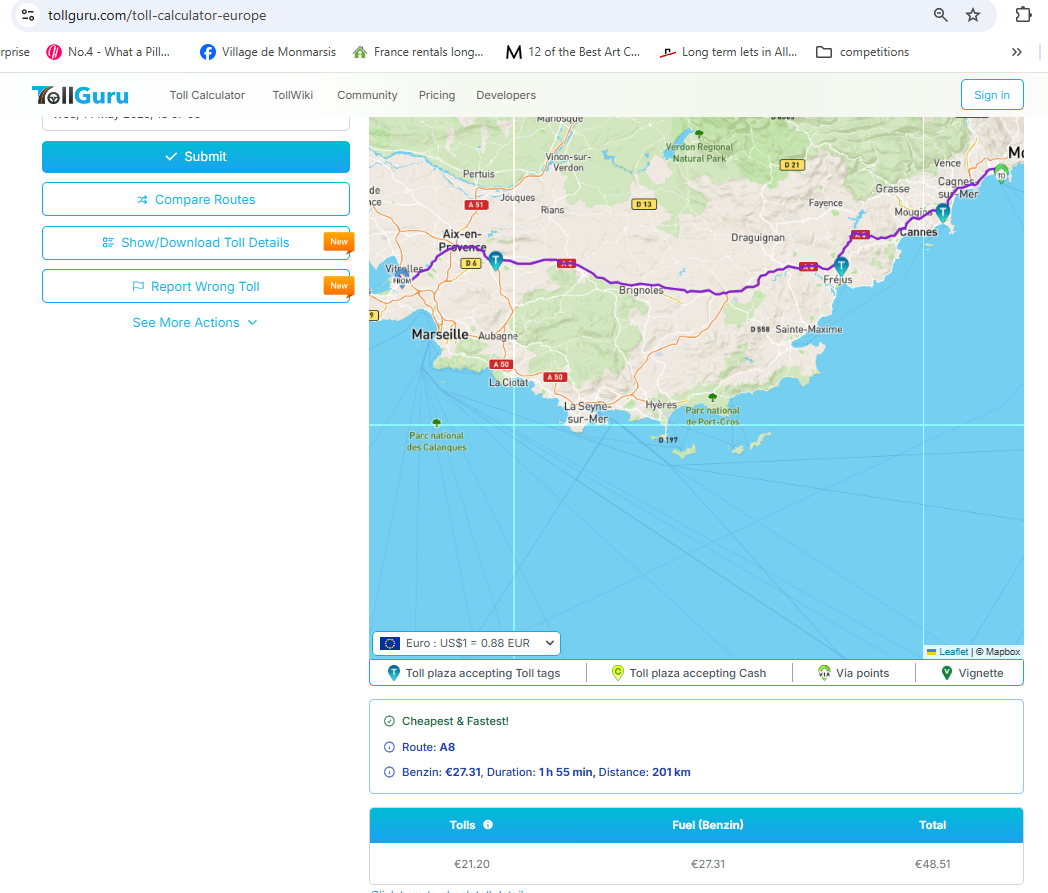
- Estimate your tolls and mileage here