THE BASICS: French Culture
 Food is a huge deal. It is hard to overstate how important food is in French culture. There are many customs, rules, norms, and common preferences you are not likely to know, and, because food is such a practical, everyday issue, these are differences that you are likely to encounter quickly. Because food is such an important, nearly sacred part of culture, it is important to approach this subject carefully. You can truly offend a French person by holding cavalier notions about food. Watch and learn.
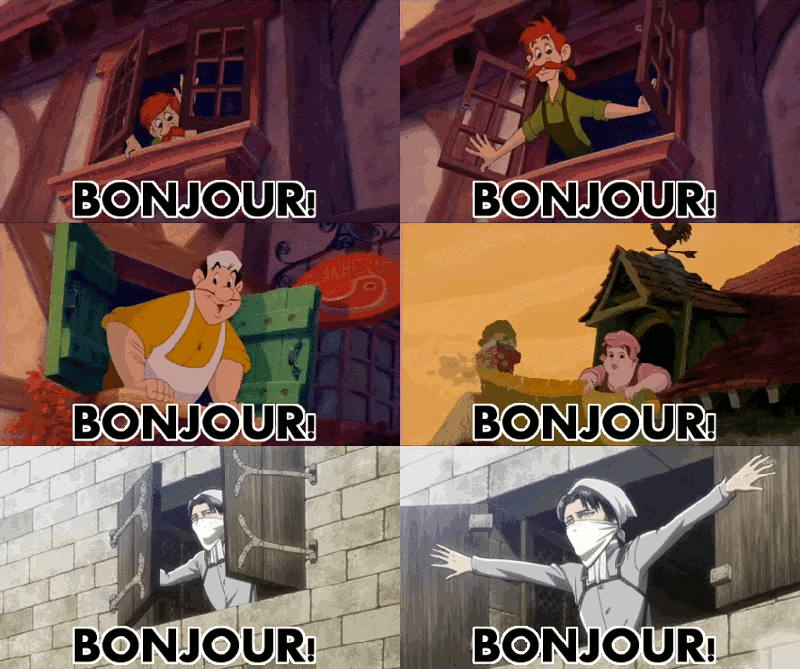
Formality: There is more formality in everyday life in France. Certain customs are nearly universally observed, and for the most part, they are not likely to be known to newcomers. Example #1: ALWAYS SAY BONJOUR!!! The greeting of a person, before launching into the conversation, is an absolute minimum. There is no faster way to prove you are the ‘rude foreigner’ than to fail to say ‘bonjour.’
Patriotism/ National Identity: One could write books on this topic.
- The republican ideals of liberty, equality, and fraternity, originating in the French Revolution, are bedrock values. The emphasis on fraternity can translate into an expectation that “Everyone is French.” Ethnic and cultural heritage is not emphasized in the same way as with cultures whose history is more influenced by immigration. French identity focuses on assimilation—immigrants are expected to fully adopt French values and culture. Secularism is a formal value that further suppresses individual expression of one’s religious heritage, e.g., Students are forbidden from wearing religious symbols in public schools. Multiculturalism is often rejected in favor of universal citizenship , which can lead to tension around ethnic and religious expression.
- The French expect their government to be the protector of civic values, public interest, and national unity. The French government is highly centralized (in large part, thanks to Napoleon). One example: in public education, each class in each school throughout mainland France and its territories will use the same textbook, and may be on the same page on the same day. Other cultures may find these aspects of the French government to be heavy-handed. It could be said that the French people have a greater tendency towards universalism than individualism, especially in how the laws are made.
- Demonstrations of patriotism are likely to be more subtle and civic-oriented. You will see national symbols like the flag or anthem on official occasions in France, but rarely in a front yard or on a piece of a person’s clothing.
Physical Proximity: Closer proximity is normal than in Northern European or American cultures. Touching is accepted including la bise, the cheek kiss), and is not at all romantic, just a common greeting among friends and acquaintances.
Pace/The Art of Living: Leisurely pace is more the norm than not. Quality, propriety, and courtesy are likely to take precedence over efficiency.
Punctuality is maintained but more relaxed than in many English-speaking or Northern European cultures.
Privacy: In general, the French are more private than many other cultures. This is reflected in many ways. High fences prevent even a glimpse of the properties. Oversharing is seen as eccentric or immature — even to the extent that asking what someone does for a living might be considered prying.
Punctuality: Less important than in Nordic, Germanic and English-speaking cultures. More important than many cultures to the south. When in doubt, ask, as there are particular rules for particular settings. (eg, work vs. social life, regional variations)
Smoking: There is more smoking in France. Smoking outdoors in restaurants is permitted, which, in the case of the many establishments where tables are in close proximity, may seem extremely rude for non-smokers new to France. It is the norm in France, and complaints about smoke outside will not get results. Luckily, smoking indoors is almost universally prohibited.
Size: Living spaces are smaller. Gestures are smaller. Rooms are smaller, elevators are smaller, and conversational voices in public are quieter.
Work-Life Balance: This is a surprisingly important difference, as you see it threaded throughout the culture in many different ways. The French are less likely to define themselves by their work than many other cultures,particularly more than Northern European and English-speaking cultures). This affects daily life in many big and small ways.
- Small Ways: To name just one example, the amount one might tip a server is influenced by the fact that they make a decent wage and are likely to have 6 weeks of vacation. (So, for example, tips are not a necessity for the server.) These benefits are not seen as perks in France but rather the normal minimum any worker should expect. Vacations, in general, are more important, and the schedules of many aspects of daily life are affected by school, employee, and summer vacations. Not taking vacation is seen as a reason for concern, not a badge of honor of a hard worker.
- Larger ways: Work is less important to one’s identity and self-worth. Joy, pleasure and well-being hold at least an equal value for most French. If you come from a culture more defined by one’s work, it can take a lifetime to understand and adjust to this. For example, the recent political fight over raising the retirement age in France reflected this value. The French, in general, believe that taking time to enjoy one’s life is a value worth respecting. The notion that less work = laziness/moral failing is simply not widely held in French culture. Instead, while working hard is also a value (The French worker is one of the most productive workers of the Western countries.) it is also moral strength to preserve parts of one’s life for things other than work. Balance, more than all work or all play is the goal.